Holdout tests for small businesses: how to find out what your marketing caused
How to run a holdout test to find out what your marketing actually caused: a practical, step-by-step guide for Australian business owners.
A holdout test keeps one comparable group away from a change, runs the change for everyone else, then compares the two over the same weeks. The gap is what the change caused. It does not require a data science team.
Most marketing reports show you what happened after a campaign started, not what the campaign did. Revenue may have risen because of your activity, or because a competitor closed, or because it was simply a better time of year. A holdout test separates those explanations from each other.
What is a holdout test?
Split your audience, customers or geography into two groups. One group, the test group, receives the campaign or change. The other, the holdout group (also called a control group), does not. Run both groups for the same period, then compare outcomes.
This is fundamentally different from a before-and-after comparison. A before-and-after reading asks whether numbers went up after the campaign started. A holdout test asks whether numbers went up more for people exposed to the campaign than for comparable people who were not. That distinction matters because seasonality, a competitor closing nearby, a price change or a new staff member can all move numbers on their own. The holdout group captures that background movement so you can subtract it.
A holdout test is the most common form of incrementality testing, the broader practice of measuring what marketing actually added, rather than what it coincided with.
When a holdout test is worth running
Good fits
A new ad channel or campaign you are about to launch.
An always-on channel you suspect does little, such as brand search or retargeting audiences who would have converted anyway.
An email or SMS sequence added to your booking workflow.
A referral offer or loyalty incentive sent to part of your customer base.
A new follow-up process for enquiries, such as a call within two hours versus your current practice.
Poor fits
Very low volumes. If your business completes a handful of jobs a month, a few weeks of data will not give you a meaningful result. You need enough activity in both groups to see a real difference.
Changes you cannot physically keep away from a group. If a price change applies to everyone on your website, there is no clean holdout.
Situations where withholding the change from customers for several weeks would do them real harm. Patient safety, for instance, comes before measurement.
How to run a holdout test in five steps
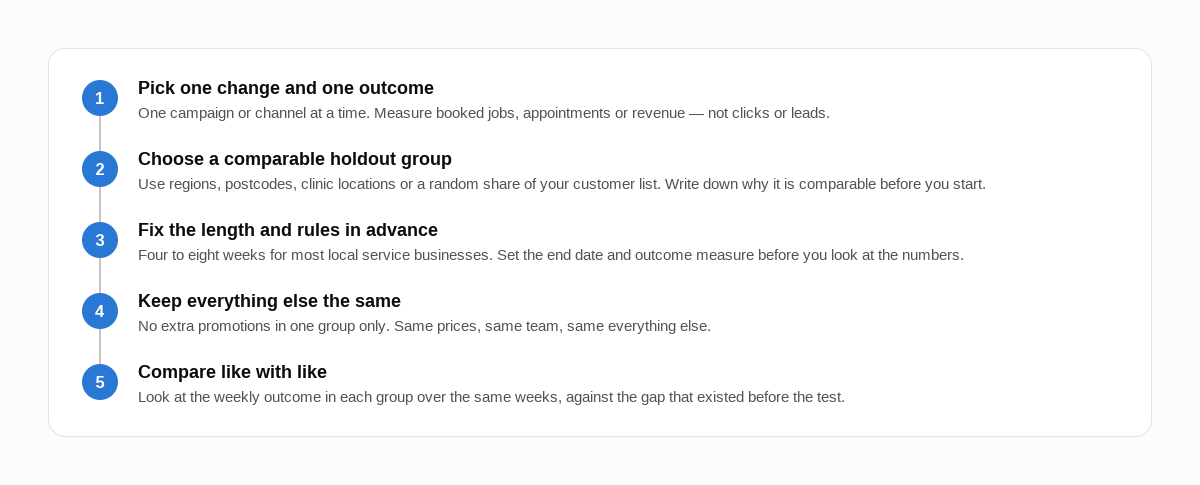
1. Pick one change and one outcome
Test one thing at a time. Launching a new social media campaign and redesigning your landing page simultaneously means you cannot know which one moved the needle. Pick the campaign. Leave the landing page alone until after the test.
Choose an outcome that reflects real business value: booked jobs, confirmed appointments, signed contracts, revenue. Not clicks, not leads, not form fills. Leads that do not convert are not the goal of your business, and optimising for them can mislead you badly.
2. Choose a holdout group that behaves like everyone else
The holdout group must be as similar as possible to the test group before the test starts. Common approaches for local service businesses include:
A geo holdout: suburbs, postcodes or regions that look like your active areas in terms of past job volumes and demographics.
Clinic or store locations: hold back two of your six locations, run the change at the other four.
A random share of your customer list: randomly split the list so each sample comes from the same population, often holding back 20 to 30 per cent.
Alternating weeks: for some channels, rotating exposure week by week can work, though it is harder to keep clean.
Write down, before the test starts, exactly why you believe the holdout group is comparable. If you cannot explain it clearly, the group is probably not clean enough. Keep the holdout large enough to detect a meaningful difference. Three postcodes across a forty-postcode service area is unlikely to be representative.
3. Fix the length and the rules in advance
For most local service businesses, four to eight weeks is a reasonable test window. Fewer than four weeks and you risk catching a random bad week in one group. Beyond eight weeks, more of your market changes around you.
Set the end date and the specific outcome you will measure before you look at any results. Write it down. The temptation to stop early because numbers look promising is real, and acting on it produces a misleading answer. Stick to the window and the rules you set.
4. Keep everything else the same
No extra promotions running in one group only. No price changes in one geography. Same team, same scripts, same response times. Change anything else during the test period and you lose the ability to attribute the result to the one thing you are testing.
5. Compare like with like
Look at the weekly outcome in each group over the same test weeks, then compare it against the gap that existed between them before the test started. Here is a hypothetical example to show the arithmetic.
Hypothetical example (illustrative only):
Before the test (weekly average) | During the test (weekly average) | |
|---|---|---|
Test group | 40 booked jobs | 46 booked jobs |
Holdout group | 38 booked jobs | 39 booked jobs |
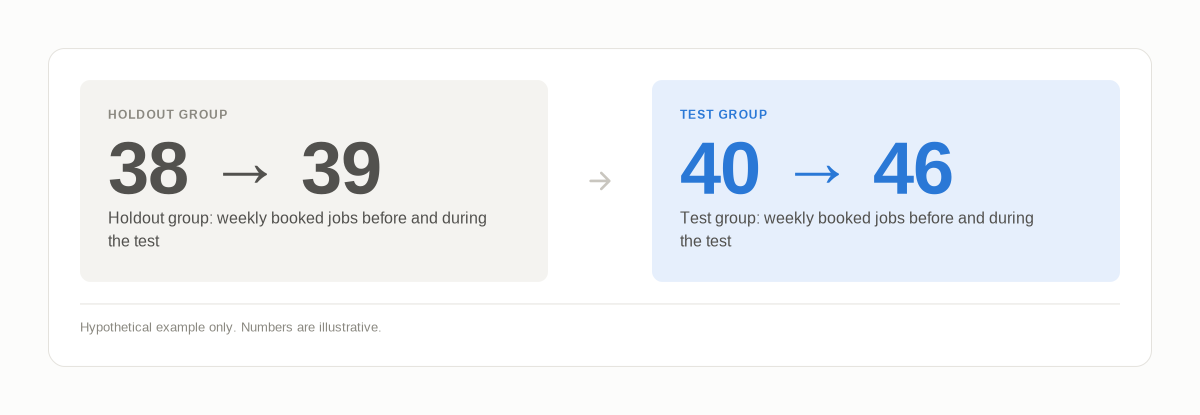
In this hypothetical, the test group gained 6 booked jobs per week (from 40 to 46). The holdout group gained 1 (from 38 to 39), which is the background lift. So the campaign added approximately 5 booked jobs a week above what would have happened anyway. Weigh those 5 jobs against what the campaign cost per week. If the revenue exceeds the cost, the campaign earned its place. If it does not, you have a clear answer that no dashboard correlation would have given you.
How to read the result
A gap that holds after accounting for the pre-test difference between groups is a genuine result. One that disappears once you adjust for pre-existing differences means the change did not earn its cost.
Small differences are harder to interpret. If the test group gained 2 jobs and the holdout gained 1, that single-job difference could be noise. Be honest: the test is inconclusive. Run it again with a larger holdout group, a longer window, or both. Do not scale spend on an inconclusive result.
Even a clear positive result should be confirmed with a second run before you commit to significantly more spending. Two consistent tests give you confidence.
Common mistakes
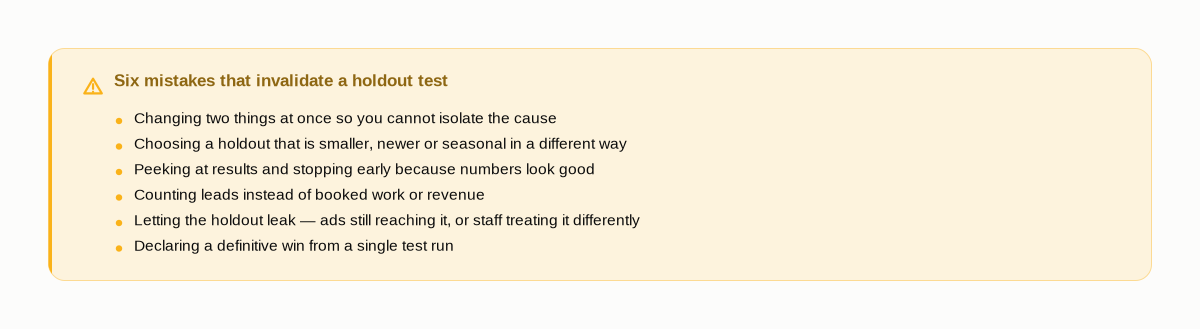
Changing two things at once, so you cannot isolate what caused any movement.
Choosing a holdout that is smaller, newer to your business, or seasonal in a different way from the test group.
Peeking at results mid-test and stopping early because the numbers look good.
Counting leads or form fills instead of booked work and revenue.
Letting the holdout leak: ads still reaching people in it because targeting is imprecise, or staff treating holdout customers differently once they know about the test.
Declaring a definitive win from a single test and scaling spend immediately.
Holdout tests, marketing mix models and attribution
Attribution reports, the kind built into most ad platforms and analytics tools, assign credit to the last click, the first click, or some blend of touchpoints. They are useful for understanding the customer path, but they cannot prove cause. A channel that appears in the path before every conversion may have done nothing to cause those conversions.
A marketing mix model takes a different approach, looking across your whole budget over a long period to estimate the contribution of each channel. That is useful for broader strategy, but it is not built to check a single change quickly.
A holdout test sits between the two. It checks one change directly and cheaply, and it is the best way to validate the outputs of attribution models and marketing mix models, because it produces a direct causal estimate rather than a statistical inference from past spend patterns. To measure marketing ROI with real confidence, holdout tests are where that confidence comes from.
Start with one test
Pick the spend you are least sure about. Usually it is a channel you have been running for a long time without ever checking whether it drives incremental business. Run one clean test there first, before you commit more budget. The result will either confirm the spend is working or redirect your budget somewhere better. Either outcome is useful.
Good measurement and experimentation does not need to be complicated. It needs to be honest, structured and consistent. If you'd like help designing your first holdout test and reading the result, book a 30-minute diagnostic call.
Frequently asked questions
How long should a holdout test run?
For most local service businesses, four to eight weeks is a practical window. Fewer than four weeks risks catching a random fluctuation in one group, while more than eight weeks increases the chance that something unrelated changes in your market during the test.
How big should the holdout group be?
Big enough to reflect the same kind of customer or geography as the test group, and large enough for a meaningful difference to show up in the numbers. A holdout of three postcodes across a forty-postcode service area is unlikely to be representative. For a customer list, a randomly assigned 20 per cent holdout is a reasonable starting point.
Can a small business run a holdout test without special software?
Yes. The core of a holdout test is deciding who gets exposed to a change and who does not, made in advance and recorded carefully. You need a way to track your outcome (booked jobs, appointments, revenue) for each group over the test period. A simple spreadsheet handles that. The discipline matters more than the technology.
Is a holdout test the same as an A/B test?
They share the same logic: compare a group that gets a change with a group that does not. The difference is scope. An A/B test usually compares two versions of a web page or message and reads the result within days. A holdout test, sometimes called a marketing holdout test or a test and control study, usually works at the level of a whole campaign, channel or region over several weeks, and measures business outcomes such as booked jobs and revenue rather than clicks.