Imaging Specialists
- Industry
- Healthcare and imaging
- Location
- Rouse Hill, NSW
- Stage
- Strategy · Build
- Status
- Booking engine and reception desk in production; new site launching
- Year
- 2026
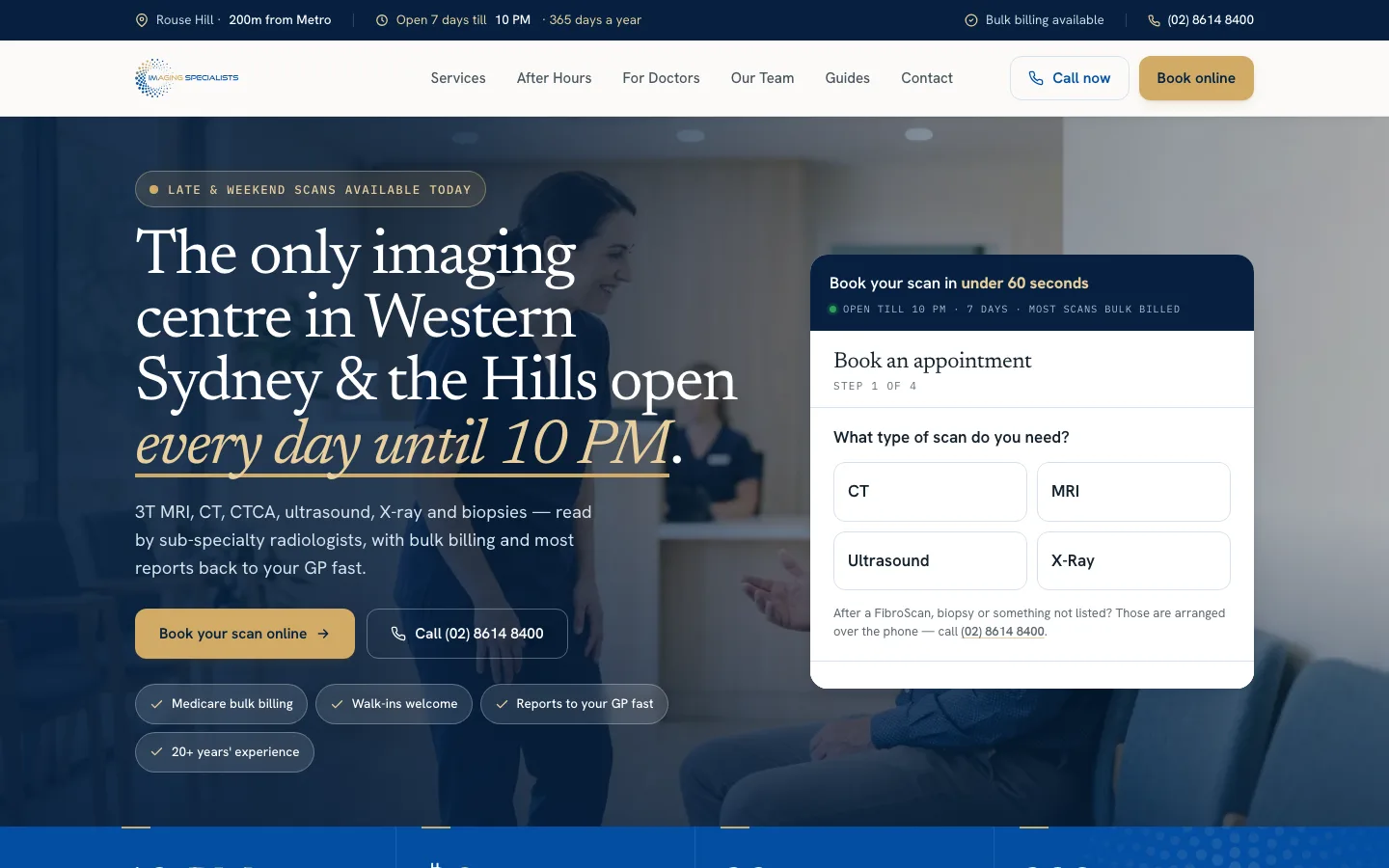
Conversion rate up 10×, from 0.1% to 1%. After we restructured and redesigned the booking and enquiry forms, ten times as many visitors to Imaging Specialists turned into bookings and enquiries, measured over 8 weeks against the previous 8. Over the same period, non-branded search clicks grew from zero to seven a day, so patients now find the practice without already knowing its name. Patients can book 69 exams online, straight into the practice's clinical system.
Results
- Conversion rate up 10×, from 0.1% to 1%, after the forms were restructured and redesigned (measured over 8 weeks against the previous 8).
- Non-branded search clicks grew from zero to seven a day (measured over 8 weeks against the previous 8): patients now find the practice without already knowing its name.
The challenge
Imaging Specialists is a diagnostic imaging practice in Rouse Hill that runs MRI, CT, ultrasound, X-ray and more, every day until 10 PM. Bookings, confirmations, referral chasing and prep calls all ran through reception, and a third-party booking tool sat between patients and the practice's clinical system, so a patient who wanted a CT scan on a Saturday morning usually had to wait for someone to pick up the phone.
The clinical system holds live patient records with no test copy, so anything we built had to be safe against it from the first day.
What we did
On-site discovery
We captured how the clinical system really behaves on site, then designed every booking path around it, with protections against double bookings and wrong-timezone appointments.
Online booking for 69 exams
Patients choose their scan, see real available times and book in about a minute. 69 exams are bookable online, each checked against the practice's live catalogue; anything else is routed to a phone call, because some scans need a conversation with the team first.
Forms rebuilt for conversion
The booking and enquiry forms were restructured and redesigned so more of the patients who start a booking finish it. This is the change behind the 10× result.
The reception desk
An action queue of confirm calls, referral chases, prep calls, no-show rebooks and freed-slot alerts; a day board for every room; and staff sign-in with an audit trail on every change.
A phone booking agent
Built to answer the calls reception misses, booking through the same engine. It never gives medical advice and hands urgent or distressed callers to a person on the team.
A new patient website
Pages for every scan and location, suburb pages, scan guides and radiologist profiles, written from the practice's own content. We removed fabricated testimonials and only quote real reviews, which matters more in health care than almost anywhere else, because patients and referring doctors both read them.
What healthcare website design has to get right for medical imaging
Most medical imaging websites are built like brochures: a list of modalities, a map and a phone number. That works for the patient who already has a referral and knows the location, but it does nothing for someone searching for an ultrasound or X-rays near them, and it leaves every booking to reception.
For a diagnostic imaging practice the website has to answer what patients and healthcare professionals actually ask: what the scan is, how long the procedure takes, how to prepare, whether a CT scan (computed tomography) uses contrast material, how much radiation exposure is involved, and when the next free time is. Then it has to let the patient book on their phone without a call, and handle their details carefully, because a booking carries patient data straight into the clinical system. GPs who refer patients read the same pages, so the content has to be accurate enough for them and plain enough for a nervous patient. That was the brief, and this case study covers how we met it.
What's next
The new website goes live on the practice's domain once final sign-offs land. The phone agent and patient messages follow.