All servicesRun · CRO agency, Sydney
Conversion rate optimisation, judged on bookings and sales
Buying more traffic is the expensive way to grow. If 1 in 1,000 site visitors books, doubling your marketing spend gets you one more booking. Getting 10 in 1,000 to book gets you ten, from the same visitors, without paying Google another cent.
We run conversion rate optimisation (CRO) as a standing programme for Sydney service businesses. We find where website visitors drop out, rank the fixes by likely lift, ship each change against a control group, and keep only what raises qualified leads, bookings and sales.
- 0.1% to 1% conversion rate
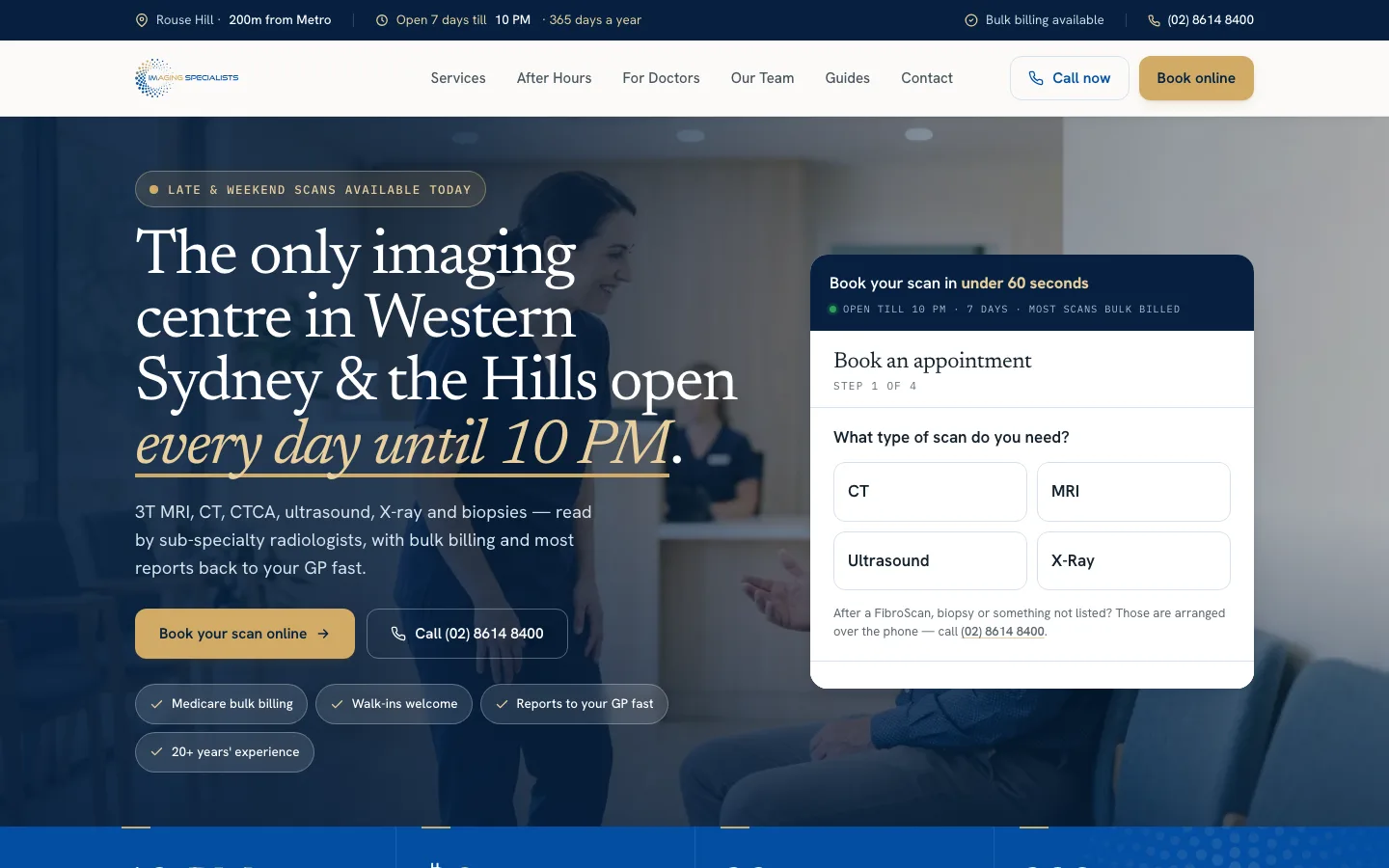
- Imaging Specialists, a diagnostic imaging practice in Western Sydney and the Hills, after the booking and enquiry forms were restructured and redesigned
- Read the case study
- 0.2% to 2% conversion rate
- High Demand Electrical, a Sydney Level 2 electrician, after the same kind of rebuild. Both measured over 8 weeks against the previous 8
- Read the case study
What is conversion rate optimisation?
Conversion rate optimisation is the work of getting more of your existing traffic to take the desired action, whether that is a call, a quote request or a booked appointment. Your website conversion rate is that action divided by visits, so a site turning 2 in 100 visitors into enquiries has a 2% conversion rate. Raising it is usually cheaper than increasing traffic, because every extra enquiry comes from existing visitors you have already paid for, which pulls down your acquisition costs on every channel at once. Even modest improvements add up: lifting a web form from 1% to 1.5% is half as many leads again from the same visits.
There is no useful average conversion rate to aim for, in our view, because a clinic booking form and an emergency plumber's call button behave nothing alike. The number that matters is your own baseline, read the same way before and after each change.
What a CRO agency should actually do
Plenty of CRO work is cosmetic: a new button colour, a bigger hero image, a heat map nobody reads twice. Those changes are easy to sell and hard to tie to revenue, which is why we judge CRO services on paying customers rather than clicks.
A conversion rate optimisation agency earns its fee in three places:
Finding the leak
Which website pages carry the money, and exactly where on those pages people give up. We identify areas from user behaviour in the data, and usually it is a form, a booking step or a phone number that's hard to tap on mobile pages.
Fixing the right thing first
A ranked list of changes, ordered by how many qualified enquiries each is likely to add and how long it takes to build.
Proving the fix worked
Each change shipped against a control and read on the key metrics that matter, bookings or sales, not clicks, scroll depth or time on page.
If a CRO agency can't show you the third one, you are paying for opinions.
Where the biggest conversion gains usually sit
On the service businesses we work with, the largest wins have come from the forms and booking steps, not from the homepage.
Imaging Specialists: booking a real time instead of requesting a call
Patients were landing on the practice's site, looking and leaving. Booking meant filling in a request and waiting for reception to call back. We rebuilt the booking and enquiry forms and connected online booking to the practice's clinical system. Patients now choose their scan, see real available times and book in about a minute. 69 exams are bookable online, each checked against the practice's live catalogue, and anything else is routed to a phone call.
Conversion went from 0.1% to 1%, measured over 8 weeks against the previous 8. Ten times the bookings from the same traffic.
High Demand Electrical: forms in the order a customer thinks about the job
The enquiry and booking forms were restructured and redesigned so more of the people who start an enquiry finish it and become a booked job. Conversion rose from 0.2% to 2% over the same 8-week comparison. Because the ads now land on a page that converts, each click is worth more, and that is part of why cost per booked job fell from about $1,000 on Google Search ads to $40.
The pattern repeats across trades, clinics and professional services: fewer fields, questions asked in the order the customer thinks about the job, tap-to-call on every page of a mobile site, a clear call to action with social proof beside it, and a real appointment time instead of "we'll be in touch". None of it is clever, but potential customers notice every bit of friction you remove.
What our CRO programme includes
Conversion research
Conversion funnel analysis from your website analytics (usually Google Analytics), session recordings of how users interact with the pages that matter, form-field drop-off, and the questions customers ask on the phone before they book. That behavioural data and user research tell us what to test. We also read what happens after the form: how many enquiries are spam, how many your team can't reach, how many turn into jobs.
A ranked test roadmap
Every idea goes on one list with its expected lift written down before anything is built, plus the effort to ship it. The biggest likely gains go first. That written expectation is how we hold ourselves to account later.
Controlled tests
Where traffic allows, a split test (A/B testing) sends part of your visitors to the new version and part to the old one, and we read the difference in qualified enquiries. Multivariate testing, where several elements change at once, needs far more traffic than most service businesses have, so we rarely recommend it. Where traffic is lower, we make bigger changes and compare changed pages against similar pages left alone, or read 8 weeks after against the 8 weeks before.
Build and rollout
Winners are built into the site properly, not left running inside a testing script. Losers are removed so the site doesn't fill up with old experiments slowing every page down.
Form optimisation and booking flow fixes
Most of our programmes start here, with form optimisation: removing fields, reordering questions, adding tap-to-call and replacing "request a call" with a real booking flow where the system allows it. These are the changes behind both client results above.
Tracking to the outcome
Every form, call and booking is tracked to the page and campaign that produced it, and where possible through to the CRM or booking system, so a test is judged on booked work.
How conversion is measured
We report conversion rate the plain way: enquiries or bookings divided by visits, for the same pages, with the same tracking, before and after. Then we check customer quality alongside volume, because a form that doubles submissions by attracting spam has not doubled anything, and more leads that never become net new customers are not a win.
Our client results use the same rule: "measured over 8 weeks against the previous 8". Eight weeks smooths out a single busy week or a public holiday. Where volume allows, we add a control group so seasonality can be separated from the change. Where it doesn't, the readout says so.
For the detail on test design, read our incrementality testing guide.
CRO, landing pages or a rebuild?
These are three different jobs, and we will tell you which one you need.
- Conversion and landing pages builds new pages and forms for a campaign or key search. It's a project, and landing page optimisation after launch rolls into CRO.
- CRO, this page, is the ongoing programme that keeps testing and improving what's live after launch.
- Web design is for when the whole site is the problem: too slow, too thin to rank, or built on something that can't be changed easily. A rebuild is a bigger job, and it is often where the forms get fixed first.
If you are planning a rebuild, our website redesign guide covers how to keep rankings and enquiries through it.
Our CRO process
30-minute diagnostic call
Your traffic, your conversion rate, and where you think enquiries are being lost.
Written proposal
Scope, the result we expect, how it will be measured and the cost.
Baseline
Conversion rate, qualified enquiries and bookings by page, recorded before anything changes.
Research and roadmap
Where the value leaks, and the ranked list of fixes.
Test and ship
Changes go live against a control, read on qualified outcomes.
Readouts and the next round
What each change caused, what we keep, what we test next.
AI agents do the routine work through machine.work, our own platform: tracking checks, test monitoring, weekly reports. Your team approves every change before it goes live.
Who it suits
- Sydney businesses with steady website traffic and a flat enquiry rate.
- Practices and trades where customers still have to "request a call" instead of booking a time.
- Advertisers whose paid traffic lands on pages that leak, so marketing spend buys visits but not jobs.
- Teams that change pages often and can't say which change helped.
It suits you less if your site has very little traffic. Then the first job is getting found, and a CRO programme can come later. See SEO in Sydney or Google Ads management.
Client work
Imaging Specialists
Conversion rate up 10×, from 0.1% to 1%. After we restructured and redesigned the booking and enquiry forms, ten times as many visitors to Imaging Specialists turned into bookings and enquiries, measured over 8 weeks against the previous 8. Over the same period, non-branded search clicks grew from zero to seven a day, so patients now find the practice without already knowing its name. Patients can book 69 exams online, straight into the practice's clinical system.View case study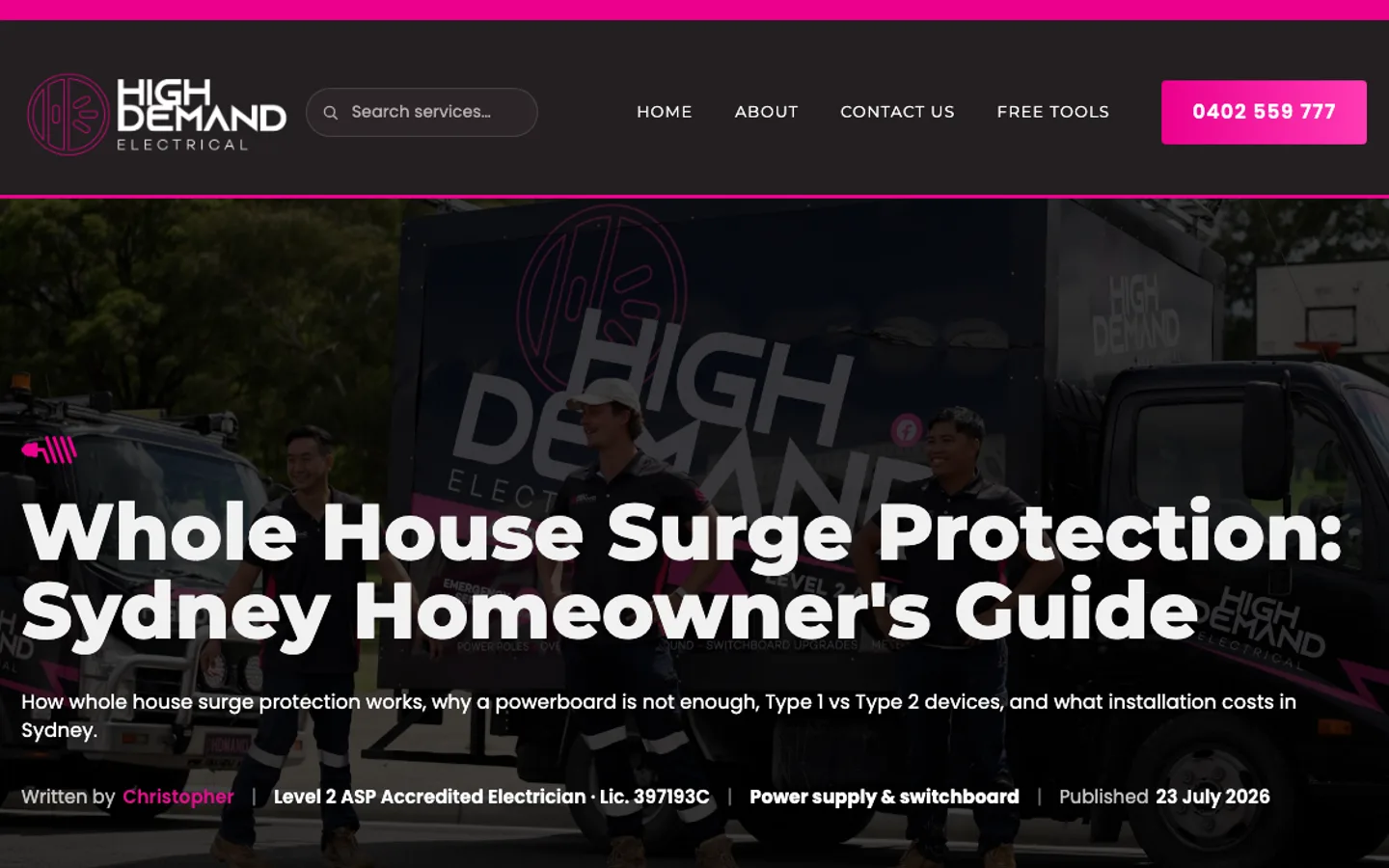
High Demand Electrical
High Demand Electrical is a busy Level 2 electrical business in Sydney. Its Google Search ads were costing about $1,000 for every booked job; that figure is now $40, measured over 8 weeks against the previous 8. Over the same period the enquiry and booking forms, once restructured and redesigned, lifted the conversion rate 10×, from 0.2% to 2%, and the blog went from 4 articles to 23 in three weeks, every one published by AI agents and checked on the live website. This is electrician marketing run as one programme, with SEO, Google Ads and the site all judged on booked jobs.View case study
Questions
How much does conversion rate optimisation cost?
A one-off rebuild of the forms and key landing pages starts at $2,500 + GST. Ongoing CRO services in Sydney are scoped to how many pages and tests are in play and quoted as a fixed monthly fee in the written proposal, before you commit. If we already run your ads or SEO, CRO can sit inside that work.
What does a CRO agency in Sydney actually do?
Finds where visitors drop out, ranks fixes by likely lift, tests them against a control, and keeps only what raises qualified enquiries, bookings and sales.
How much traffic do we need for CRO?
Enough to read a result in a reasonable time. With lower traffic we test bigger changes and use before-and-after reads with a comparison group, so you still get an honest answer, just a slower one.
How long does a CRO test take?
Most need several weeks of data. Our published client results were read over 8 weeks against the previous 8.
Is A/B testing the same as CRO?
A/B testing is one tool inside CRO. The research that decides what to test, and the tracking that judges it on booked work, matter more than the testing software.
How is this different from Conversion and Landing Pages?
That service builds new pages and forms. CRO is the ongoing programme that keeps testing and improving them after launch.
Can you connect online booking to our system?
Usually. For Imaging Specialists, online booking writes to the practice's clinical system, with 69 exams bookable. See web development in Sydney for booking and CRM integrations.
Do we own the changes?
Yes. The pages, forms, tracking and data are yours.