Static Computers
- Industry
- IT and managed services
- Location
- Sydney, NSW
- Stage
- Strategy · Build
- Status
- Delivered; launching on the client’s domain
- Year
- 2026
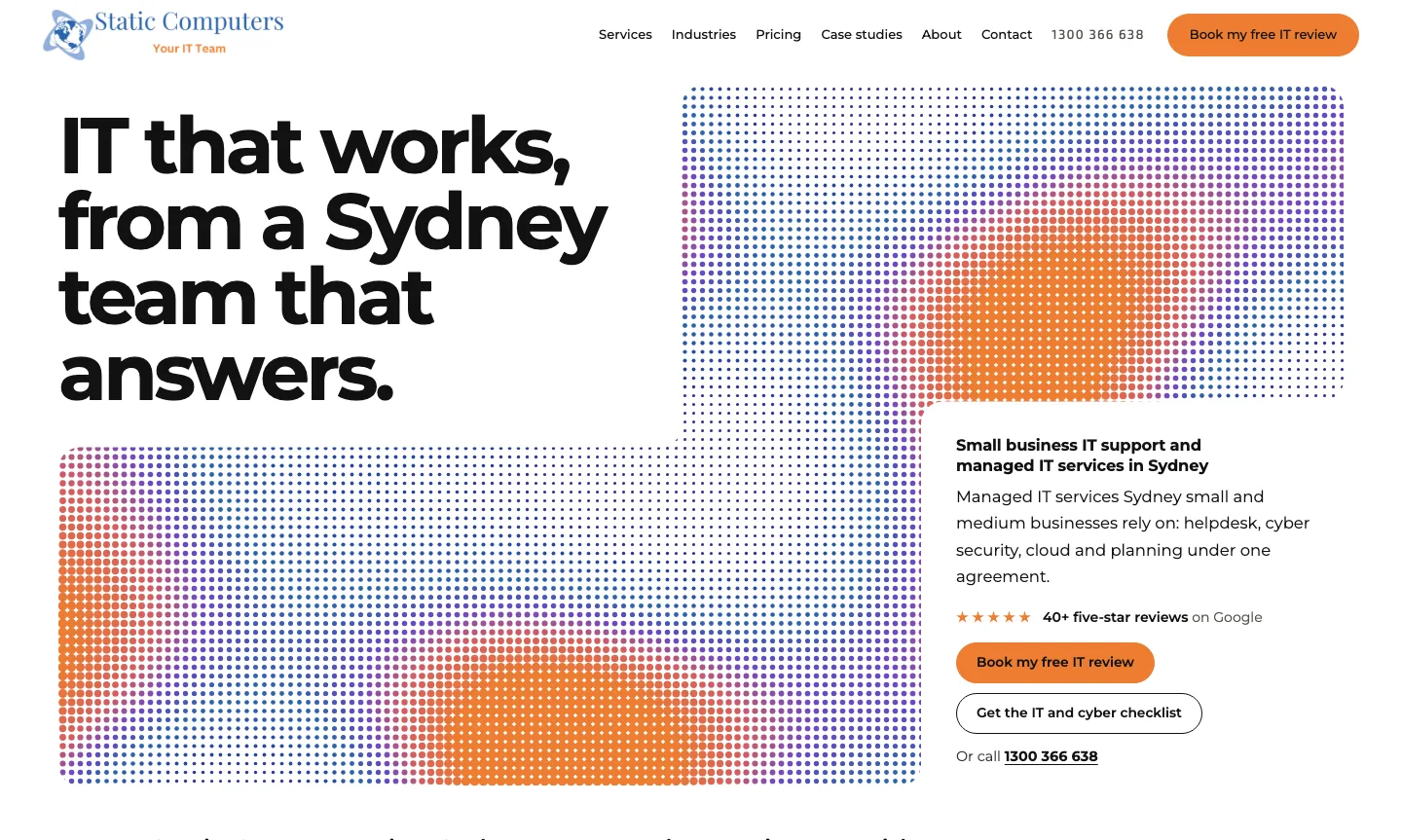
A new position, a search-ready site and enquiries that land in the CRM. Static Computers has run IT for Sydney businesses since 2006. We repositioned it around one promise, "IT that works, from a Sydney team that answers.", regrouped its services into four buckets, and rebuilt the site with service, industry and location pages, every old address redirected, and a call-back form that creates the contact and a task in its CRM. The site is delivered and launching on the client's domain. There are no measured results yet; we'll publish them once the site has been live long enough to read.
The challenge
Static Computers has served Sydney businesses for nearly two decades, but its website was slow, hard to find in search results, and gave no clear reason to call. Services were scattered across pages, the message wasn't results-led, and the case studies said little about what the team had fixed.
The goal was simple: more booked IT reviews, landing in the CRM the team already works from.
What we did
Positioning
A results-led headline, "IT that works, from a Sydney team that answers.", and services regrouped into four clear buckets: Support, Protect, Cloud and Advise. Most MSP sites list every service in the order the provider thinks of them, but buyers arrive with a problem (the server is slow, a staff member clicked a phishing link), so the buckets are written around those problems.
Four design directions
We built four directions on identical content so the team could choose by seeing the options rather than imagining them, and the chosen one was then rolled out to every page.
Service, industry and location pages
Hub pages for each service, industry and location pages, guides and a glossary, written for the searches their buyers make. Location pages are the local SEO piece, and they work as landing pages: a business in a nearby suburb looking for IT support should find a page about their local area, not a generic Sydney page. The old blog was carried across at its original addresses, so existing search engine rankings weren't thrown away.
Real proof only
Named client stories, real Google reviews and client logos, which build trust in a way stock customer testimonials never do. Any missing fact showed as a visible placeholder until the client supplied it, so nothing on the site was made up to fill a gap.
Migration without lost links
Every old address maps to its new page, with an automated check that each one redirects once, straight to a live page. A website migration is where most rebuilds lose traffic, and it's usually because nobody tested the redirects.
Leads into the CRM
A short call-back form that creates the contact in their CRM with a note and a call-back task inside business hours, tested end to end.
What MSP website design needs to do
A managed service provider sells something buyers can't see until it goes wrong, so the MSP website has to do the explaining a sales call would otherwise do. In our view that means saying plainly what the business will look after (IT support, cyber security, cloud), backing it with social proof from named clients and real reviews, and making it easy for a potential customer to request a call without the long contact forms most MSP sites use. Page speed and a clear user experience matter here too, because an office manager comparing managed IT services in Sydney will usually open four or five sites side by side and close the slow one first.
Most MSP marketing we see gets this backwards. The site lists every product the provider resells, the security risks are described in vendor language, and the only call to action is a generic "contact us" box, so visitors who arrived with a real business need leave without asking and conversion rates stay low.
What's next
The client is moving the site onto their own hosting and switching the domain over.