All servicesBuild · Landing page design, Sydney
Landing page design that turns your traffic into enquiries
Before you buy more traffic, make the traffic you already have work. We are a landing page agency in Sydney that designs landing pages for your campaigns and key searches, rebuilds the forms and booking flows that leak enquiries, and tests every change against a control group so you know which ones lifted results.
- 0.1% → 1% conversion rate
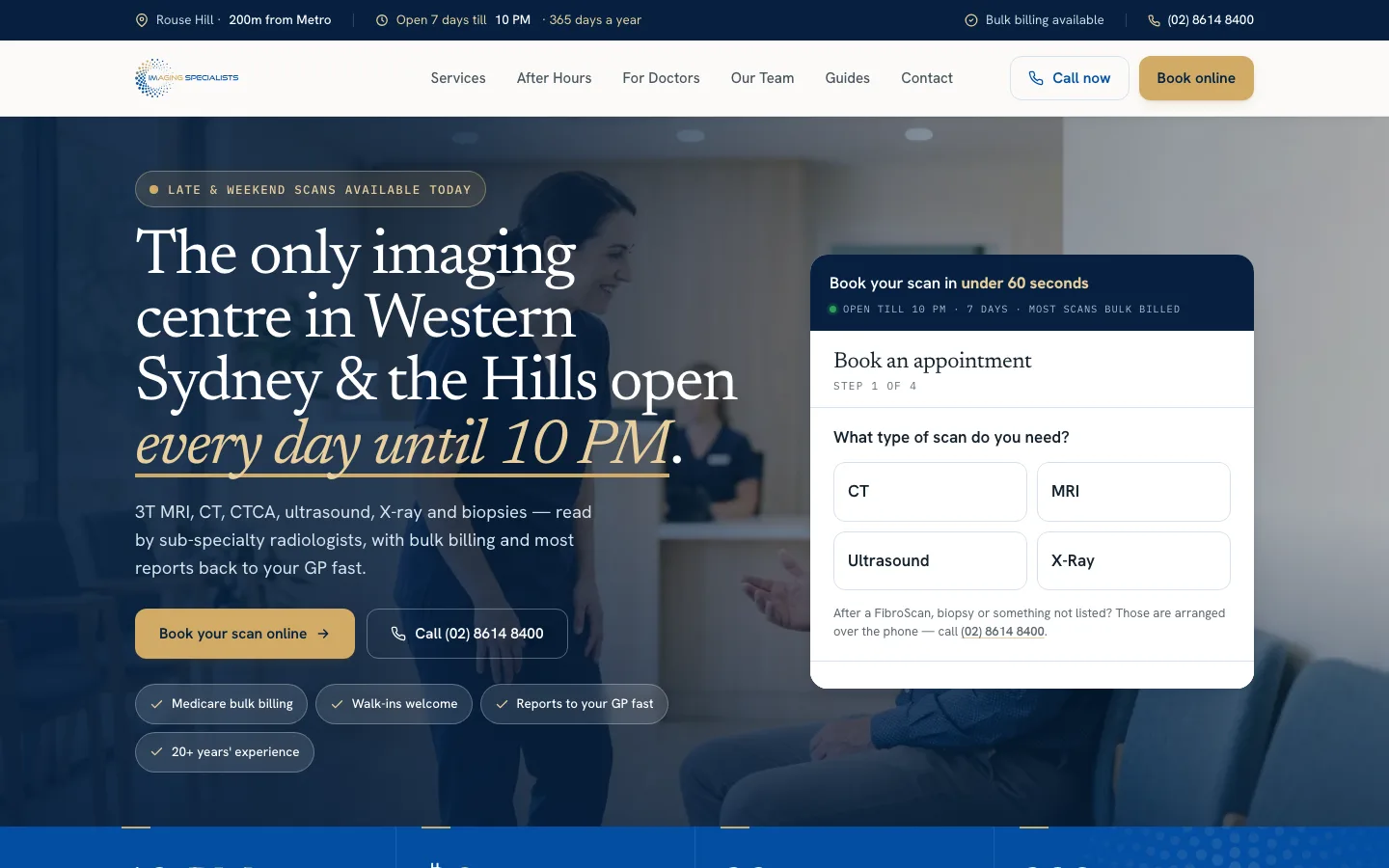
- for Imaging Specialists, a diagnostic imaging practice in Western Sydney and the Hills, after the forms were restructured and redesigned (measured over 8 weeks against the previous 8)
- Read the Imaging Specialists case study
- 0.2% → 2% conversion rate
- for High Demand Electrical, a Sydney Level 2 electrician, after the same kind of form rebuild (measured over 8 weeks against the previous 8)
- Read the High Demand Electrical case study
Why the page matters more than the click
Here is the arithmetic. A page converting at 0.2% turns 1,000 visitors into two enquiries. The same page at 2% turns them into twenty. You paid for the same 1,000 visits either way.
That is why we look at the landing page before the ad budget. A 10× lift in conversion rate cuts your cost per lead to a tenth, whether the visitors came from Google Ads, Meta, organic search or an email. Both of our 10× results came from the same place: forms that asked too much, in the wrong order, on a page that didn't match what the visitor came for.
(The 1,000-visitor figures are an illustration, not a client's numbers.)
Who landing page design suits
- Businesses running ads to their homepage, or to service pages that were never built for paid traffic.
- Sites with steady traffic and a low enquiry rate. Plenty of visits in your analytics, not many calls.
- Clinics, trades and service firms with long or clunky booking forms. Patients or customers start a booking and give up halfway.
- Teams that change pages often but can't tell what helped. A new headline in March, a new button in May, and no record of which one did anything.
What landing page design includes
Landing page design sounds simple, one page and one goal, but most of the pages we are asked to fix try to do five things at once. Here is what we build into each one.
Landing pages built for one job
Each page is built for a specific campaign, search or target audience, with one clear action. Someone searching "switchboard upgrade" should land on a page about switchboard upgrades, with photos of that work, the suburbs you cover and a short form. Not on the homepage with fourteen links in the menu, where the visitor has to work out for themselves which of your other pages to try.
The layout above the fold
The top half of the page, the hero section, carries the main headline, one line of proof and the call to action, because on a phone that is often all a visitor reads before deciding to stay. Further down come the details a careful buyer wants: what the job involves, what it costs, who does it and what happens after they enquire. For a tradie that is usually a price range, real job photos and the licence number; for a clinic it is what to bring, how long the appointment takes and whether a referral is needed.
Message match for landing pages for Google Ads
The headline repeats what the ad or search promised, which matters most on landing pages for Google Ads because the visitor clicked on a specific promise thirty seconds ago. Social proof sits above the fold: licence number, reviews, a price range where you can give one, response time. The visitor shouldn't have to scroll to find out they're in the right place.
Forms and booking flows rebuilt
This is where most of the gain usually sits. We go through the form fields one at a time with whoever answers enquiries, cut the ones your team doesn't use, split long forms into short steps, put the easy questions first, and add instant booking or tap-to-call where it fits. At Imaging Specialists, patients now choose their scan, see real available times and book in about a minute. 69 exams are bookable online, each checked against the practice's live catalogue, and anything unusual is routed to a phone call.
We keep the details your team needs. A shorter form that loses the referral or the job address only moves the work to reception.
Page speed and mobile
Most local service traffic arrives on a phone. Pages are built mobile first, load fast and keep the call button within thumb reach. Sam's Roofing Experts got a sticky call bar on mobile, tap-to-call on every page and trust details above the fold, alongside a free written-quote form with spam protection. See the Sam's Roofing case study.
Tracking to the enquiry
Every form, call and booking is measured to the page and campaign that produced it. Where you can tell us which enquiries became paying work, we track that too, so the page is judged on booked jobs rather than form fills.
A/B testing against a control group
Each change ships against a comparison: the old version of the page, a set of pages left unchanged, or a split of traffic, which is A/B testing in the plain sense. That separates the effect of the new page from seasonality, a change in ad spend or a competitor going quiet.
How a landing page project runs
- 30-minute diagnostic call. Where your traffic comes from, which pages it lands on and what happens next.
- Written proposal. Which pages and forms we'll rebuild, the lift we expect, how it will be measured and the cost.
- Find the leaks. Funnel data, form drop-off by field, session recordings and the questions your front desk keeps answering on the phone.
- Baseline. Conversion rate, enquiries and cost per enquiry recorded before anything changes.
- Design, build and test. New pages and forms shipped against a control, with the expected result written down first.
- Keep what works. Winners roll out across similar pages. Changes that didn't help are removed so the site doesn't fill with old experiments.
A worked example: an imaging practice
Imaging Specialists runs MRI, CT, ultrasound, X-ray and more, every day until 10 PM. Bookings, confirmations and referral chasing all ran through reception, and a third-party booking tool sat between patients and the practice's clinical system.
We rebuilt online booking so it connects to the clinical system directly, with protections against double bookings and wrong-timezone appointments. Then we restructured and redesigned the booking and enquiry forms so more of the patients who start a booking finish it. Conversion rate rose from 0.1% to 1%, measured over 8 weeks against the previous 8. Non-branded search clicks grew from zero to seven a day over the same period, so the better page was also being found by patients who didn't already know the practice's name.
The same pattern held at High Demand Electrical: enquiry and booking forms restructured and redesigned, conversion rate from 0.2% to 2% over 8 weeks against the previous 8. Alongside paid search judged on bookings, cost per booked job fell from about $1,000 on Google Search ads to $40.
Landing pages and ads, planned together
A landing page and the ad that sends people to it are one piece of work. When we manage Google Ads or Meta ads, pages are written alongside the ads and judged on the same number: cost per booked job or cost per sale. If you already have an agency running ads, we can build the pages and share the tracking with them.
Once pages are live, an ongoing conversion rate optimisation programme keeps testing and improving them. This service builds the pages and forms; landing page optimisation over months is the CRO work that follows, and if you are comparing a CRO agency with a landing page agency, that is the difference.
What it costs
Landing page and form work is a fixed-price Build project, quoted in the written proposal.
- Landing page and form rebuildfrom $2,500 + GST
- Booking or CRM connection behind the formfrom $10,000 + GST
- A full site rebuild, if the problem is bigger than a few pagesfrom $6,000 + GST
For what websites and pages cost across the Australian market, read how much a website costs in Australia.
Client work
Imaging Specialists
Conversion rate up 10×, from 0.1% to 1%. After we restructured and redesigned the booking and enquiry forms, ten times as many visitors to Imaging Specialists turned into bookings and enquiries, measured over 8 weeks against the previous 8. Over the same period, non-branded search clicks grew from zero to seven a day, so patients now find the practice without already knowing its name. Patients can book 69 exams online, straight into the practice's clinical system.View case study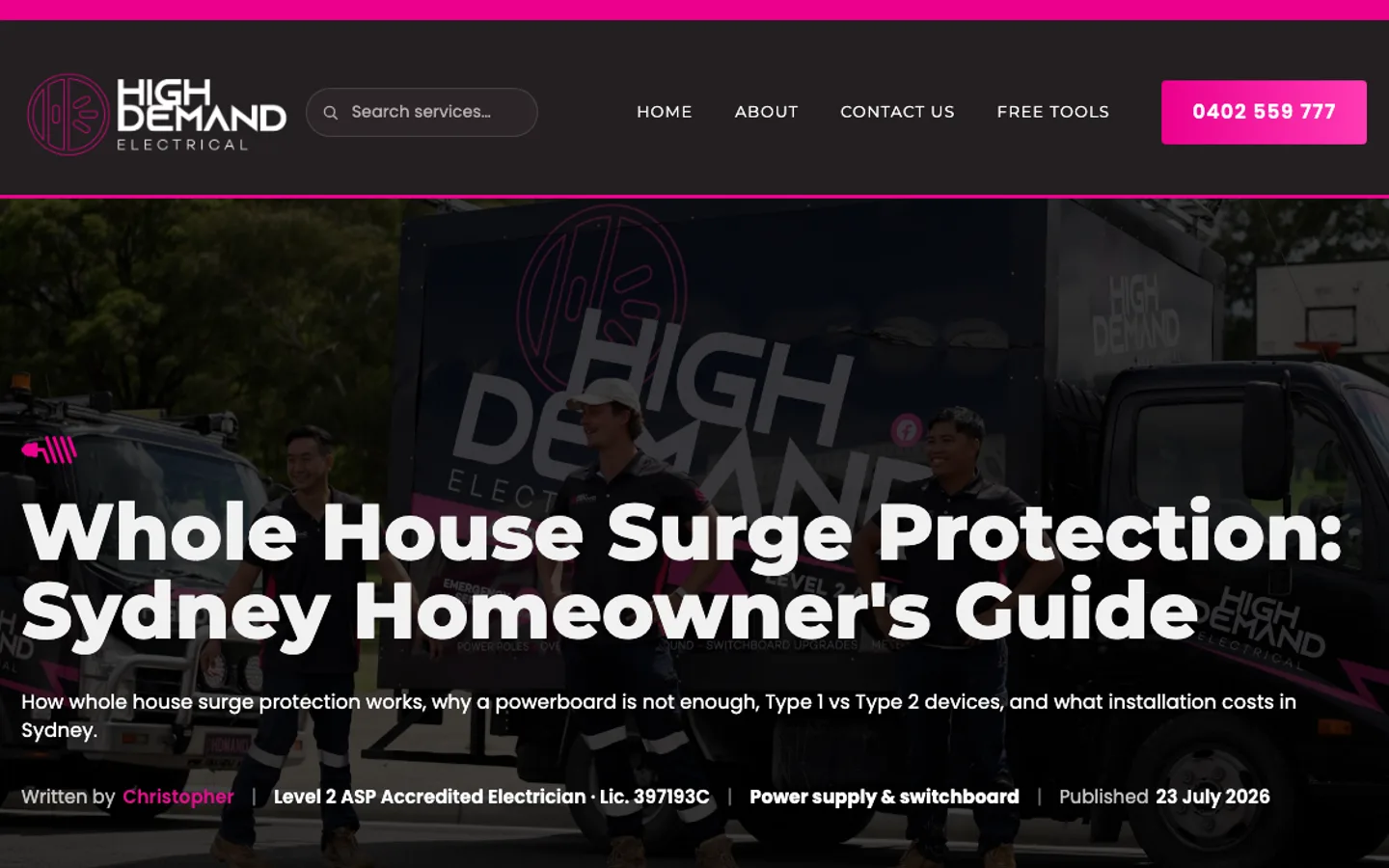
High Demand Electrical
High Demand Electrical is a busy Level 2 electrical business in Sydney. Its Google Search ads were costing about $1,000 for every booked job; that figure is now $40, measured over 8 weeks against the previous 8. Over the same period the enquiry and booking forms, once restructured and redesigned, lifted the conversion rate 10×, from 0.2% to 2%, and the blog went from 4 articles to 23 in three weeks, every one published by AI agents and checked on the live website. This is electrician marketing run as one programme, with SEO, Google Ads and the site all judged on booked jobs.View case study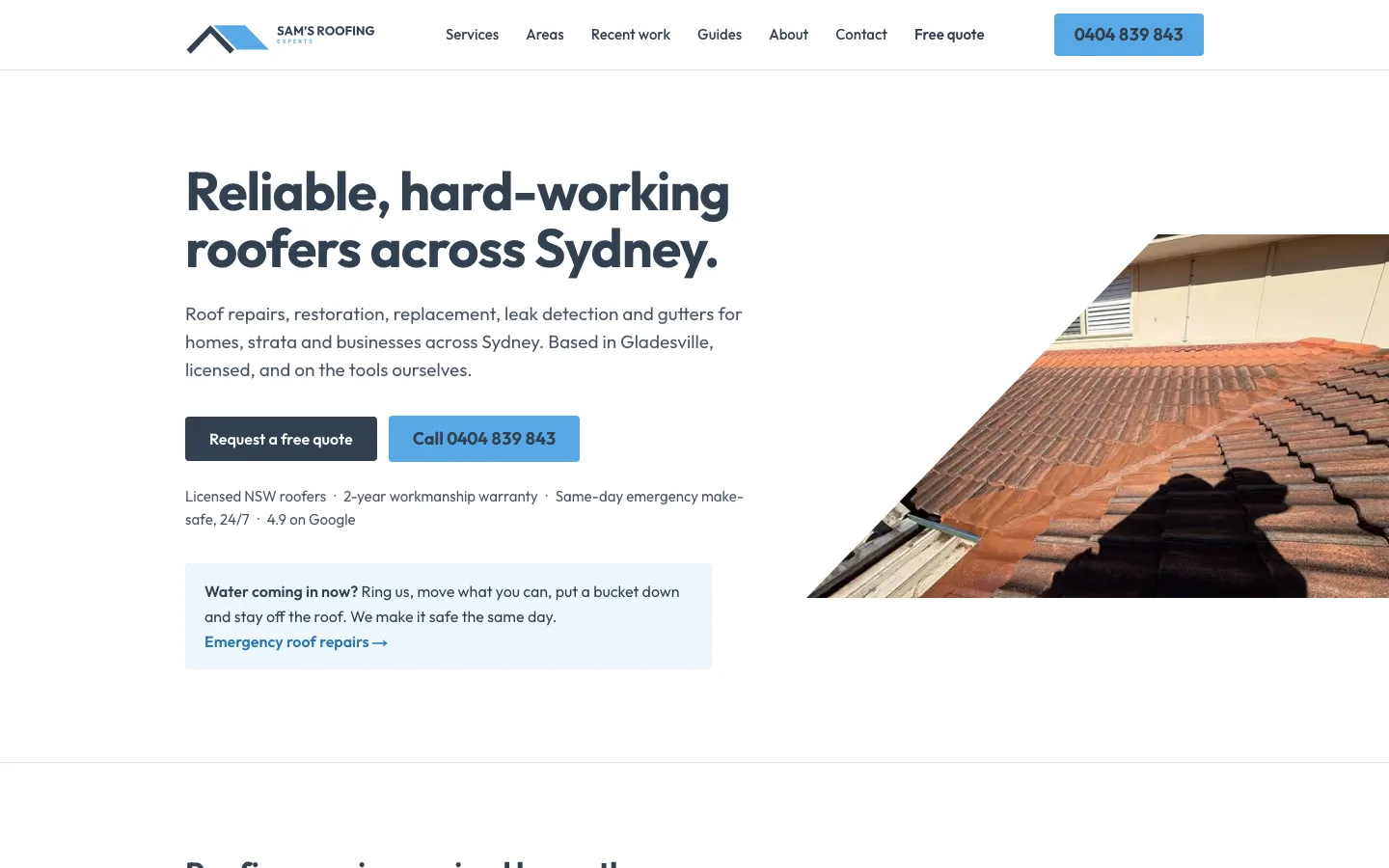
Sam’s Roofing Experts
From four pages to 130, with published price ranges. Sam's Roofing Experts is a four-person roofing crew in Gladesville. Their old website had four pages and every service was listed on one of them, so we rebuilt it as a 130-page search-led roofing website: a page for each service, a hub for each of nine Sydney regions, cost guides with published price ranges, the crew's own job photos and a free written-quote form. The site is built and launching on Sam's domain. We don't have measured results yet; we'll add them once the pages have been live long enough to compare properly with the old site. If you run a roofing business and want more calls from the suburbs you already work in, this is what we built and why.View case study
Questions
How much does landing page design cost?
A landing page and form rebuild starts at $2,500 + GST. The exact figure depends on how many pages and forms are involved and whether the form needs to connect to a booking system or CRM, which starts at $10,000 + GST. Both are fixed prices in the written proposal before you commit.
How much traffic do we need to test?
Enough to read a result in a reasonable time. If you don't have it, we make larger changes and read them before and after against a comparison group of pages, which still gives an honest answer.
Can you improve our existing pages instead of building new ones?
Yes. Often the fastest gain is the form on a page you already have. Both 10× results on this page came from rebuilding forms, not from new sites.
Can this sit alongside our ads?
Yes. Landing pages and ads should be planned together, and we can manage both or work with your current agency.
What's the difference between this and CRO?
This service designs and builds the pages and forms. CRO is the ongoing programme that keeps testing them after launch.
Do you use landing page templates?
Not bought ones. We build a small set of templates for your own site, one per type of job, so each new campaign page reuses a layout that has already been tested on your potential customers instead of starting from a blank page.
Do we own the pages?
Yes. The pages, the forms, the tracking and the data are yours.
How long until we see a result?
Form and page changes often show within weeks. Both client results above were measured over 8 weeks against the previous 8.