All servicesRun · AI Search Optimisation
AI search optimisation: get named in the answer
Your buyers now ask ChatGPT, Perplexity and Google a full question and get a written answer back. That answer names a few businesses and links to a few sources. AI search optimisation is the work of making yours one of them, and making sure what the answer says about you is right.
We do this for Australian businesses from Sydney, and we judge it the same way we judge everything else: on leads. See what this kind of work costs in our SEO cost guide.
- 0 → 100+
- mentions a day in Google’s AI answers for a West Pymble mortgage broker, and an estimated 300+ a day across all AI assistants, bringing two leads a week
- FinSavvy case study
- 1 a week
- new leads from AI search for an offshore recruiter, with the growth work run by agents
- Tarino case study
What is AI search optimisation?
AI search optimisation is improving how often, and how accurately, AI answer engines mention your business, cite your pages and recommend you when people ask questions in your category.
It goes by several names. Answer engine optimisation (AEO), generative engine optimisation (GEO, or generative engine optimization in American spelling), LLM SEO and AI SEO all describe roughly the same work. The labels matter less than the result: being in the answer, described accurately, and getting enquiries from it. How the terms differ is in AEO vs SEO.
AI search optimisation is built on SEO, not instead of it. Google's own guidance says optimising for generative AI search is still SEO, and that a page must be indexed and eligible to show with a snippet to appear (Google Search Central, checked Oct 2026). That's why this service sits alongside our SEO agency in Sydney work, and why most clients start with both.
How ChatGPT, Google AI Overviews and Perplexity pick their sources
Nobody outside these companies knows the exact rules, and they change often. The general mechanics are well enough understood to act on.
They search first. When an AI tool answers a question about a current service or a local business, it usually runs a web search, then reads the pages that come back. If your page isn't indexed or doesn't rank, it rarely gets read.
They look for a passage that answers. A page that states the answer plainly under a matching heading is easier to quote than one that takes six paragraphs to get there.
They reason about entities. Your business name, location, services and people are things the model tries to pin down. Vague or conflicting facts make you a riskier recommendation.
They check what others say. Mentions in industry publications, directories, reviews and local media are independent evidence that you are real and relevant.
Each engine is different. Google's AI Overviews and AI Mode draw on Google's own index. ChatGPT and Perplexity run their own retrieval and their own crawlers. A business can be cited by one and missing from another, so we measure each separately.
Who this suits
- Businesses whose buyers research for weeks before they call: finance, health, recruitment, professional services, IT.
- Firms that rank reasonably well in Google but never appear when someone asks ChatGPT for a recommendation.
- Businesses where AI tools state wrong facts about them: old addresses, services they don't offer, prices from years ago.
- Teams that have heard about GEO and want someone to measure it properly rather than sell them a dashboard.
If Google can't read your site properly, we fix that first.
What's included
An AI visibility audit
We build a fixed set of the questions that matter in your category, in your buyers' words: "mortgage broker on the North Shore", "how much does an MRI cost without a referral", "cost to hire an offshore bookkeeper". We run each one repeatedly across ChatGPT, Perplexity, Google AI Overviews and AI Mode, because answers vary from run to run. Then we record who gets named, which pages get cited and what is said about you. That becomes the baseline.
Pages built to be quoted
New and rewritten pages that answer real questions directly in the first sentence or two, then give the detail. Cost pages, comparisons, calculators, how-to guides and plain-English explainers do especially well, because so many AI questions are look-ups and comparisons. On FinSavvy we turned a one-page site into a search-led advice library of calculators and guides, from borrowing power to stamp duty, with lender policy cited by the date it was checked. Tarino's site was rebuilt around a plan of roughly 40 pages, with a cost calculator that shows what a hire costs through Tarino against an agency.
Consistent facts about your business
Your name, address, services, hours, licences and people stated the same way on your site, your Google Business Profile, directories and social profiles. Clear about and author pages that say who you are and why you're qualified.
Structured data where it helps
Organisation, local business, service, article and FAQ markup, matched to what's visible on the page. We're honest about its limits: Google says structured data isn't required for generative AI search and there is no special markup to add (Google Search Central, checked Oct 2026). It still removes ambiguity about who you are. It isn't a ranking trick.
Crawler access and technical checks
We check that robots.txt, your CDN and your hosting aren't blocking the crawlers you want, that key content is in the HTML rather than hidden behind scripts, and that pages load fast. If it's cheap to add, we'll publish an llms.txt file, but we won't charge you for it as a strategy. Google says you don't need new machine-readable or AI text files to appear in its AI features (Google Search Central, checked Oct 2026).
Genuine off-site mentions
Reviews, industry associations, partner pages, local media and expert comment. Real mentions from sources the engines already trust. No paid mention schemes: Google says chasing inauthentic mentions isn't as helpful as it might seem (Google Search Central, checked Oct 2026).
Ongoing publishing and monitoring
New pages and refreshes ship in batches, written and published by AI agents through machine.work. Your team approves every batch. The question set is re-run on a schedule so we can see what changed.
What we won't do
- Promise you'll be cited. Nobody can guarantee what an AI model says.
- Rewrite your whole site "for AI". Google says you don't need to write a special way for AI search or break content into tiny pieces, and we agree: write for the buyer.
- Buy mentions or plant fake reviews.
- Report a visibility score without showing you the leads behind it.
How it runs
- Diagnostic call. Thirty minutes on how you show up in AI answers today and which questions matter.
- Written proposal. Scope, the question set, the result we expect, how it's measured and the cost.
- Baseline. The audit above, plus current AI-referred visits and enquiries.
- Build and run. Foundations, then pages and off-site work in batches, approved by your team.
- Readouts. Regular readouts on mentions, citations, visits and leads. Each page gets a verdict about 90 days after it goes live.
You own everything we build: pages, content, accounts and data.
How we measure AI search optimisation
This is where most AI SEO agencies go vague. We use four measures, each recorded before work starts.
Share of answers. For each question in the fixed set, the share of runs in which you're named, on each engine. Not a single yes or no.
Citations and accuracy. Which of your pages get cited, and whether the facts stated about you are correct.
AI-referred visits. Clicks from ChatGPT, Perplexity and other assistants, separated from ordinary search and referral traffic in your analytics. Google counts clicks from its AI features in the Web search totals in Search Console (Google Search Central, checked Oct 2026).
Leads. The number that matters. We add an "AI assistant" option to your enquiry source field and phone script, and connect it to your CRM.
Every change ships against a control: questions or pages we deliberately leave alone. If the controls move as much as the changed pages, we don't claim the credit.
AI SEO agency pricing
Pricing depends on how many questions and engines you want covered and how much content needs building.
- Standalone AI search optimisation, including the visibility audit in month onefrom $2,000 + GST a month
- SEO and AI search run together from one target listfrom $3,000 + GST a month
- Minimum term3 months
If you only want the audit and a plan for your own team, we quote it in the written proposal.
For the published Australian market ranges, see the AI search section of our SEO cost guide.
GEO agency or SEO agency?
You probably don't need two agencies. The work overlaps so much that splitting it creates gaps: one team writes pages, the other complains they aren't quotable. We run both from one target list, so every page is judged on how it ranks and on how it shows up in AI answers.
Where they differ is measurement. A GEO agency that only reports rankings is doing SEO under a new name; one that only reports a visibility score isn't tracking leads.
Client work
FinSavvy
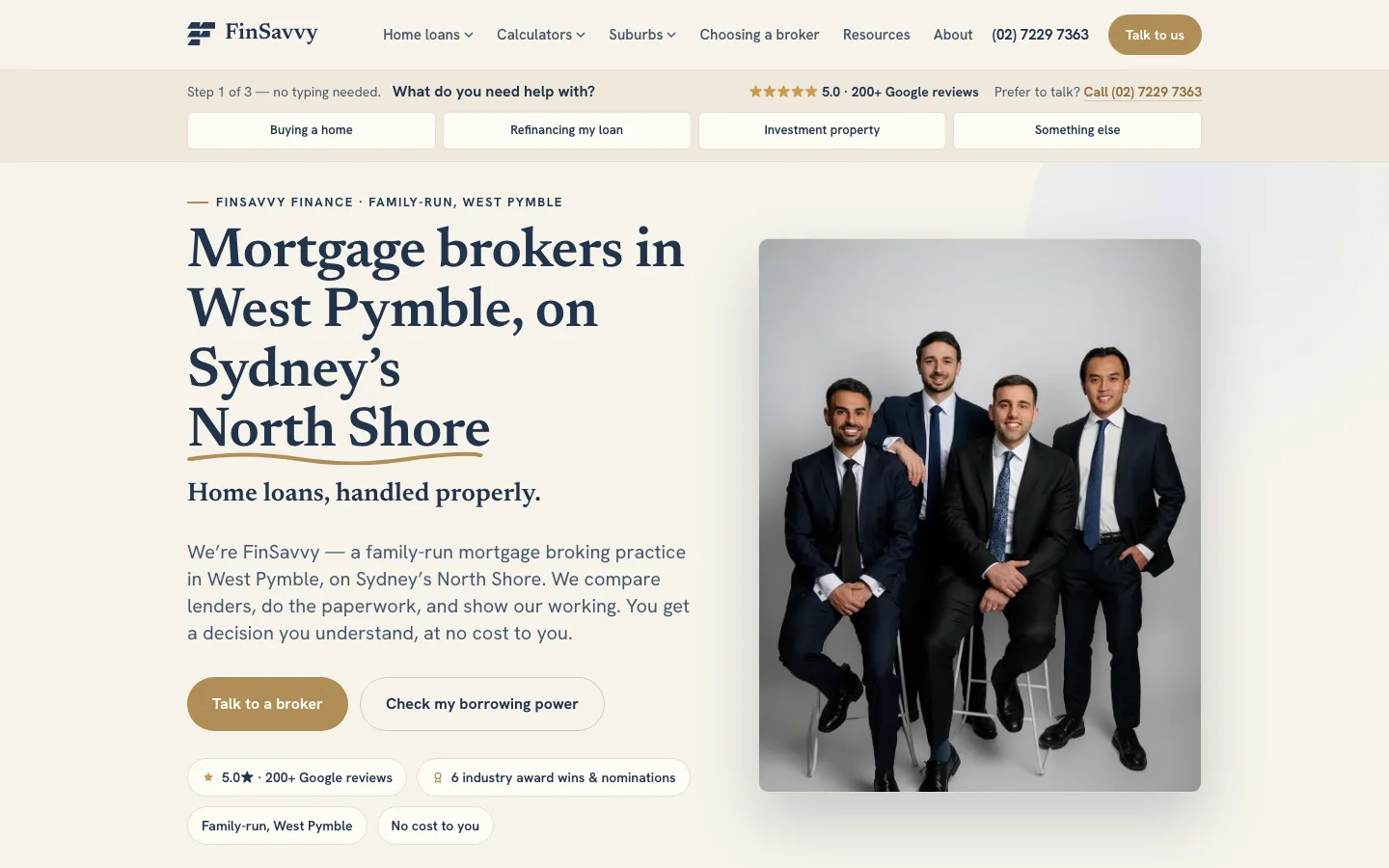
From never mentioned to 100+ mentions a day in Google's AI results. FinSavvy, a family-run mortgage broker on Sydney's North Shore, now appears in more than 100 Google AI answers a day, and an estimated 300+ a day across all AI assistants. That brings in two leads a week from AI search. The mortgage broker website behind it was a single page before we rebuilt it as a search-led advice library. If you run a mortgage or finance broking business in Australia, this shows what we built and what it changed for lead generation.View case study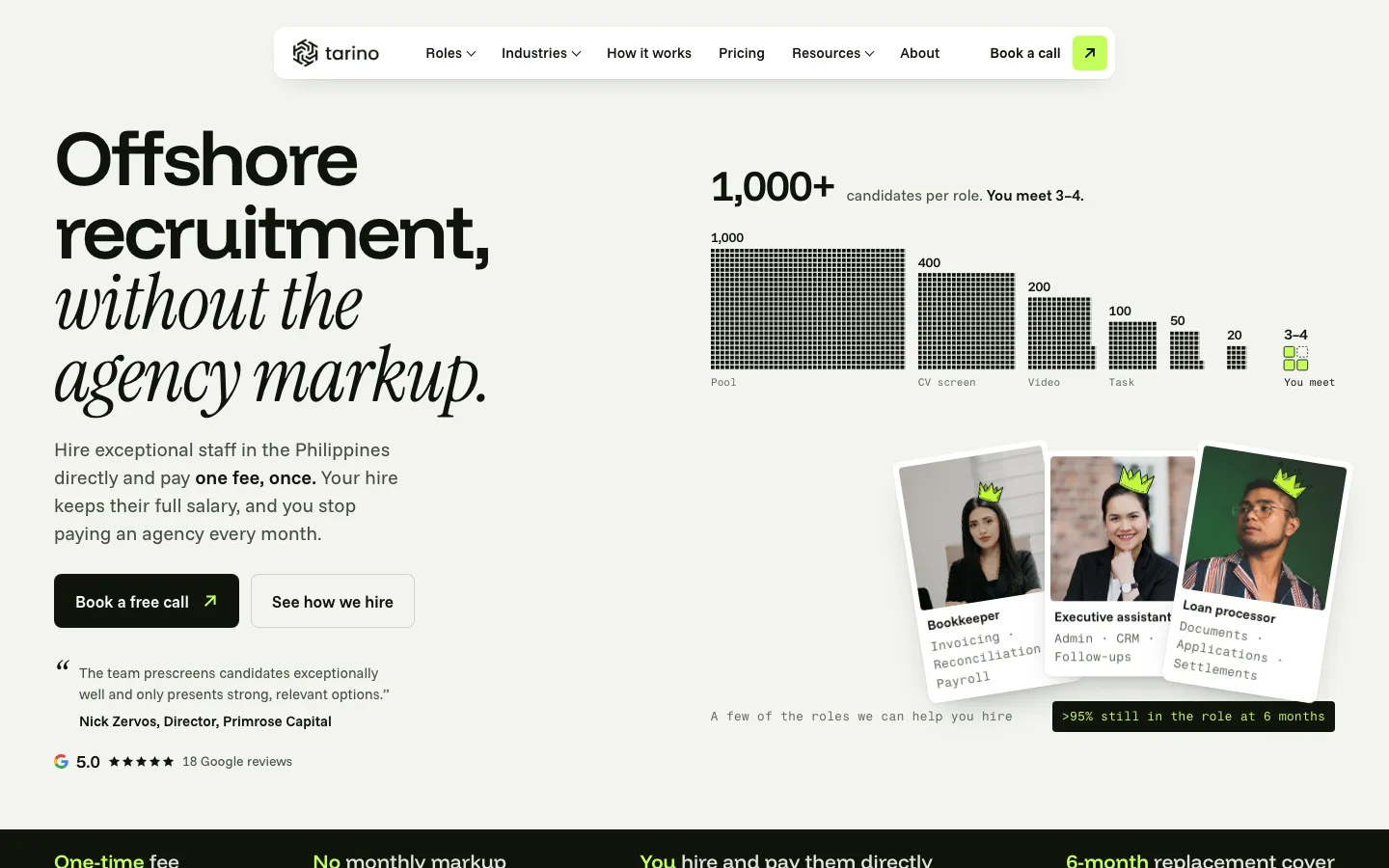
Tarino
Tarino is an offshore recruitment business that helps Australian small businesses hire offshore staff directly, without the agency markup. Its AI search programme, run day to day by agents, now brings in one lead a week. Around it we built a new search-led website on a plan of about 40 pages, a cost calculator, a brand kit and an AI sales agent that drafts outreach for the team to approve. The AI search programme is live and ongoing; the new website is built and launching, and the sales agent is launching.View case study
Questions
Is AEO the same as SEO?
Mostly. AEO and GEO use the same foundations as SEO: indexable pages, clear answers, a consistent business identity and genuine mentions. Google treats optimising for its AI features as SEO. The difference is in what you measure: being named in the answer, not only ranking on the page.
Can you guarantee ChatGPT will recommend us?
No. Nobody controls what an AI model says, and answers change from one run to the next. We commit to the work, a fixed set of questions and honest measurement of how often you're named.
How long does AI search optimisation take?
Fixes to facts and crawler access can show up within weeks, especially in tools that search live. New pages need to be indexed and earn trust first. We judge each page about 90 days after it goes live.
Do we need an llms.txt file?
Not for Google. Google says you don't need AI text files to appear in its AI features. Some other AI tools may read one, and it's quick to write, so we add one when it's cheap. It isn't a strategy. Our post on llms.txt goes into what we've tested.
Does schema markup help with AI Overviews?
Google says there is no special schema to add for AI Overviews or AI Mode. Structured data still helps machines read your facts without ambiguity, so we use it where it matches visible content. For the wider checklist, see how to rank in AI Overviews.
What does AI search optimisation cost?
Ongoing work starts at $2,000 + GST a month, or from $3,000 + GST a month alongside SEO. The first month's audit is included. The SEO cost guide has the market ranges. Book a 30-minute diagnostic call. We'll run a few of your buyers' questions through the main AI tools and show you where you appear, where your competitors appear and what to fix first.