AI admin assistant for trade businesses
- Industry
- Trades
- Location
- Australia
- Stage
- Build
- Status
- Built and tested against 18 scenarios; live connections being tested
- Year
- 2026
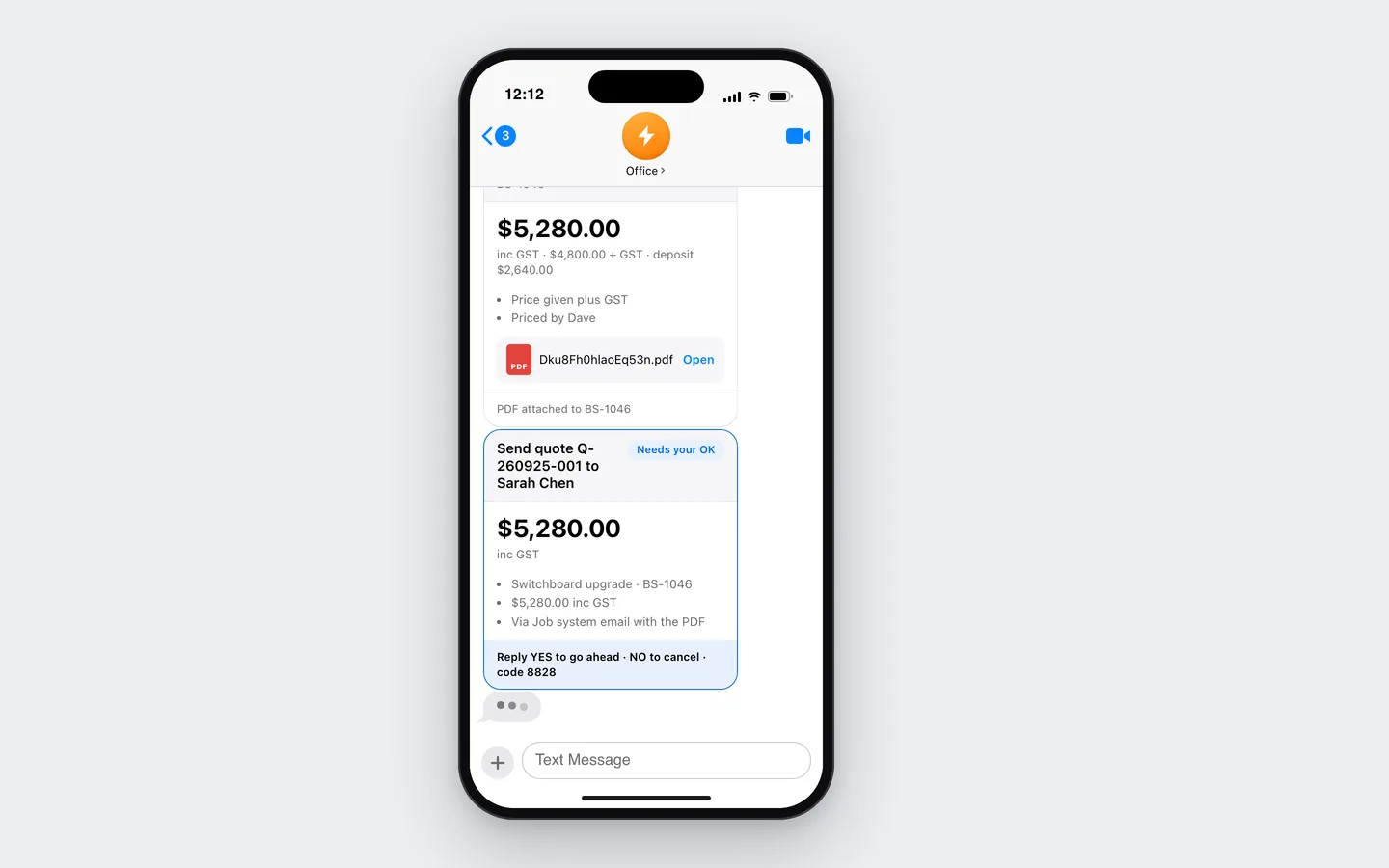
We built an AI office manager for Australian trade businesses that the owner runs by text. It writes and sends quotes, raises invoices, books jobs and keeps the job system up to date, and it asks before anything goes out. It has been built and tested against 18 scenarios, and its live connections to job and accounting systems are being tested now. There is no measured result yet.
What was delivered
- Quotes, invoices and job updates handled from a text, a photo or a voice note.
- Quote pages customers can accept, query or ask to change.
- A setting on every action, from "never" to "just do it", with trust built in five stages.
- Daily check-ins at the business's local time, and one text that switches everything off.
The challenge
Most small trade businesses have no office staff. The owner quotes, invoices, chases payments and answers customers at night, from a phone, after a day on the tools.
Office software assumes someone at a desk. This assistant had to work from the one place tradies already are, their text messages. It also had to be safe enough to trust with customers and money.
What we did
Run by text message
The owner and staff text the assistant like an office manager: plain words, photos, voice notes or PDFs. Voice notes are transcribed in Australian English. Receipts and supplier invoices are read straight from a photo.
Quotes priced from real jobs
It quotes from the price the owner gives, or prices the job from site-visit notes in the job system: hours at the business's rate plus materials from its price list. When a number is missing it asks. It never guesses. Then it attaches a PDF quote to the job.
Customers can reply
Quotes go out by text or email from the business, with a link to a quote page. The customer can accept, ask for a change or ask a question. The assistant reads the reply, tells the owner and suggests the next step, and an accepted quote moves the job forward automatically.
Paid faster
It connects to the accounting software to show who owes what. Invoices go out with a pay link, so a customer can pay straight from the message.
Asks before it acts
Every action has a setting: never, draft only, ask first or just do it. Trust grows in five stages as the owner approves its work. Sensitive actions need a four-digit code. One text switches the lot off.
Ahead of the day
Morning, midday and end-of-day check-ins arrive at the business's local time: today's jobs, quotes waiting on a reply, overdue invoices. It remembers how each business works and picks up details from conversations as it goes.
Built to run many businesses
Each business has its own data, team and history, and staff are added by mobile number. Costs are tracked per business. Connections are checked every morning before work starts, and a problem raises an alert to us before the owner notices.
What's next
The first trade businesses connect their job and accounting systems. Every customer-facing action stays approved by the owner while trust builds.